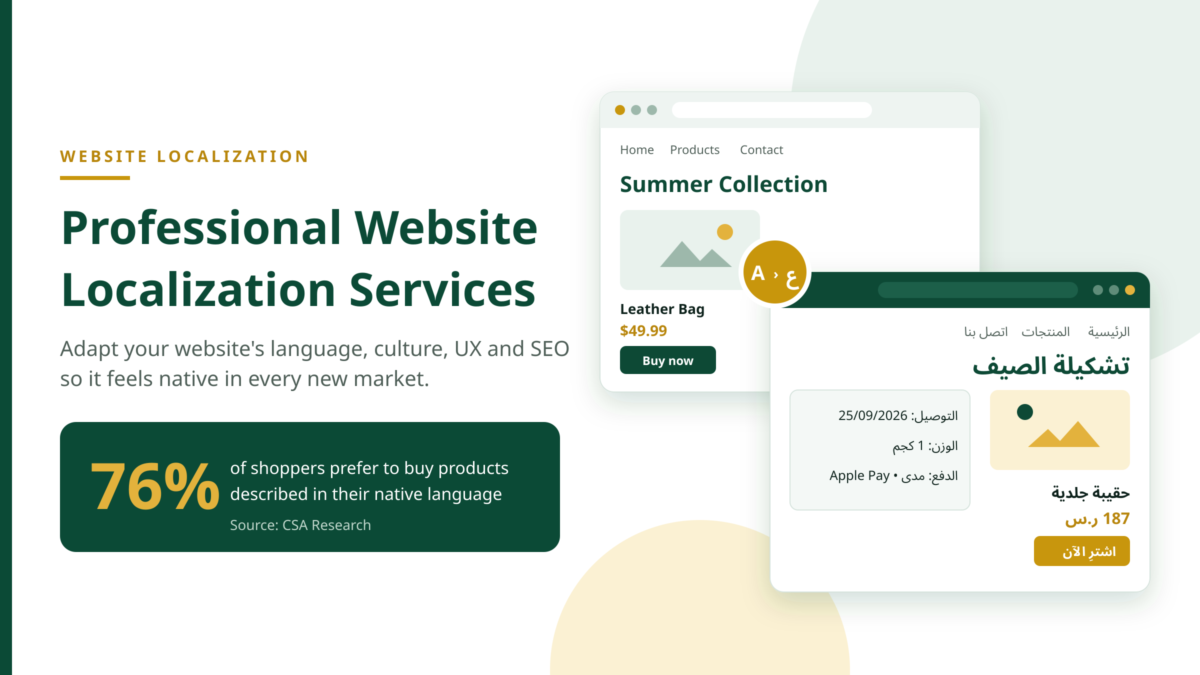
English is one of the most widely spoken languages in the world. However, research shows that people prefer to interact with websites in their native language. According to CSA Research, 76% of shoppers prefer to buy products with descriptions in their native language. That is why professional website localization services have become more important than ever for US brands and businesses looking to expand into new markets.
What Is Website Localization?
Website localization services involve adapting an entire website to the language and culture of a specific market. This includes text translation, visual elements and photos, UI, UX, payment methods, and currency, all to deliver the best local user experience for the target audience.
Why Do Website Localization Services Matter?
1. Higher Sales Rates and Increased Revenue
As CSA Research showed, language significantly affects purchasing decisions because people prefer to buy in their native language. Localized websites help reduce buyer hesitation.
For example, when Canva localized its website for the Indian market, it created multiple versions for different regions in India, including Gujarati, Hindi, and Bengali. Thanks to this level of localization, India has become Canva’s fourth-largest market.
2. Alignment with the Target Audience’s Culture
To turn visitors into customers, you have to build trust. That trust is built when people feel you are speaking to them, respecting their differences, and understanding their pain points and needs.
This includes localizing humor and cultural nuances, meeting cultural values and expectations, and understanding local holidays and high-purchasing seasons. A website that feels trustworthy and familiar to the target audience helps brands build stronger connections.
3. A Better Buyer Journey
Website localization improves the entire buyer journey: from the top of the funnel, when people start searching in their native language, to the middle of the funnel, when brands provide social proof such as customer reviews or case studies from the new market.
Even the bottom of the funnel needs localization, as customers look for familiar payment methods and need to understand shipping and refund policies.
4. Stronger Search Engine Optimization (SEO)
SEO depends on the user’s region and search language. For this reason, professional website localization services are essential for increasing brand awareness and building authority in new markets.
5. A Stronger Brand Position in New Markets
Professional website localization services help brands expand into new markets, compete with other brands, and build a positive impression among their target audience. The goal is to look like a familiar local brand rather than an imported brand with a literally translated or foreign website.
Professional Website Localization Services: Key Steps
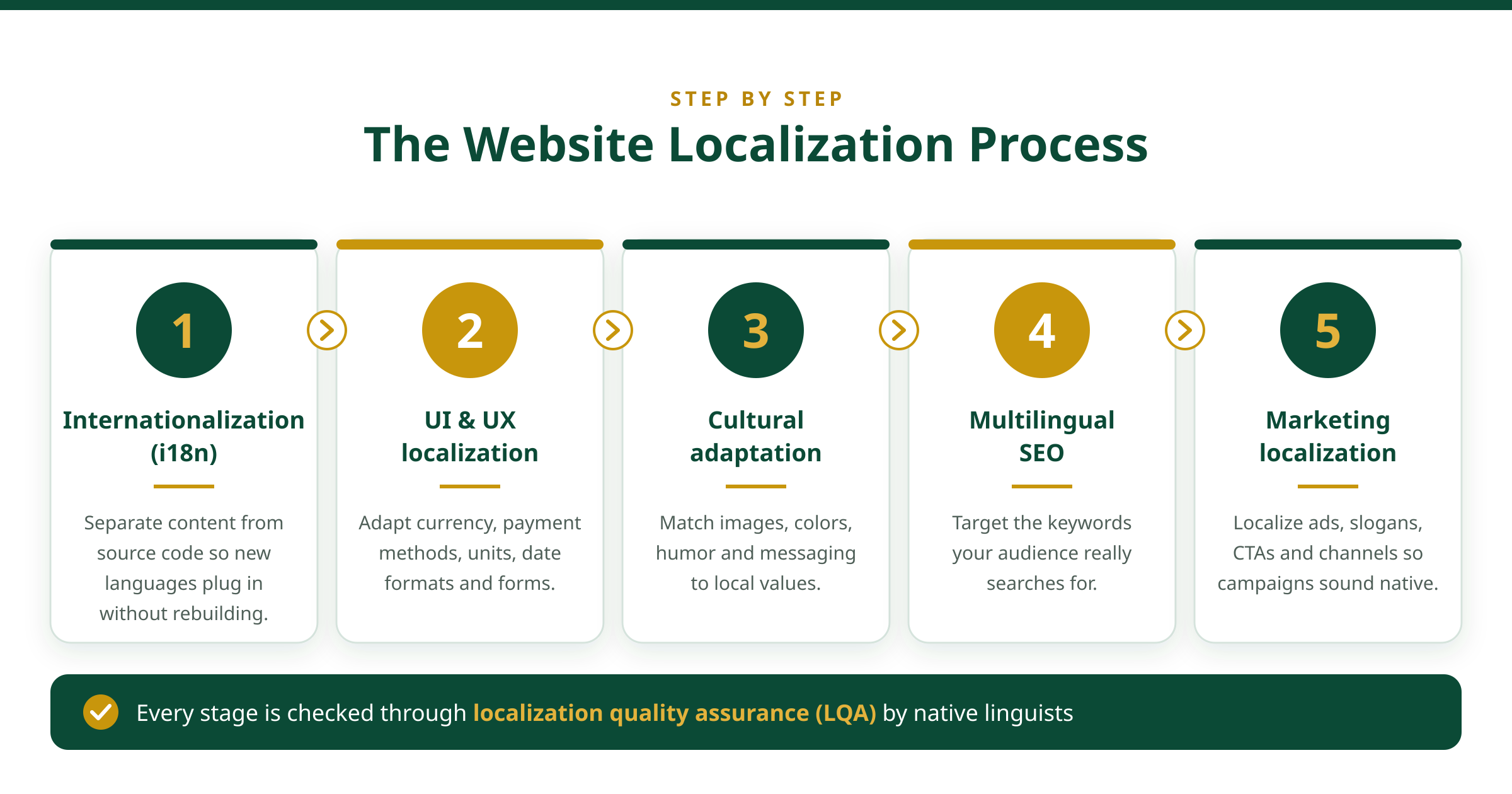
Website localization is a multi-stage process that ensures the localized website succeeds and truly matches the target audience.
1. Internationalize the Website
Internationalization makes the website ready for localization by ensuring the code is designed so content can be translated into other languages easily.
This is done by decoupling your content from the source code. Every language-specific piece of information is stored separately, which allows the site to switch languages without changing the code.
2. User Interface and User Experience (UI & UX) Localization
User experience is a critical element of professional website localization, as the website should feel familiar to the target audience. This requires localizing user interface (UI) elements, including:
- Currency and payment methods: While some payment methods, such as PayPal, are used globally, every country has its own preferred payment methods. The same applies to currency: brands should use the target country’s currency so customers can easily understand prices and avoid confusion during checkout.
- Measurement units: There are two main measurement systems in the world, the Metric System and the Imperial/U.S. Customary System. A localized website should use the one its target market uses. For example, an American brand expanding into Saudi Arabia should convert inches and pounds to meters and kilograms.
- Date formats: In the U.S., the month comes before the day (09/25/2026), while in Saudi Arabia, the day comes before the month (25/09/2026). Date formats need to be localized as well.
- Form fields: Since form requirements differ from one country to another, form fields should be adapted to the requirements of each country and region.
3. Cultural Adaptation
Considering the cultural preferences and values of the target audience is essential for successful localization. For example, Coca-Cola’s “Share a Coke” campaign printed popular first names such as “Jack” and “Sarah” on its bottles. The campaign was highly successful, and more than 500,000 photos were shared with its hashtag.
When Coca-Cola brought the campaign to China, the company identified a cultural issue: addressing people by their first names can be seen as disrespectful there, as people prefer surnames and honorific titles. Coca-Cola overcame this challenge by using phrases such as “classmate” and “close friend” on its bottles, which kept the campaign authentic while respecting local culture.
4. Multilingual SEO and Keyword Research
The terms people use when searching change from one market to another. For example, people in the U.S. search for “vacation,” while “holiday” is more common in the U.K. That is why brands need to identify the actual terms their target audience uses rather than simply translating keywords.
Implementing multilingual SEO also helps brands reach more people in specific regions or countries, improve search rankings, and grow traffic and organic reach, which reduces advertising costs.
5. Marketing Localization
After addressing the previous elements, marketing plays a vital role in helping brands succeed in new markets. Brands need to consider consumer behavior, purchasing habits, pain points, and the needs of the new market.
This means speaking the target audience’s language in marketing, from popular marketing channels and preferred communication methods to content that communicates effectively without sounding awkward or conflicting with social and cultural values. It also includes localized ad campaigns, slogans, and calls to action that feel familiar to the target audience.
How to Choose the Best Professional Website Localization Services
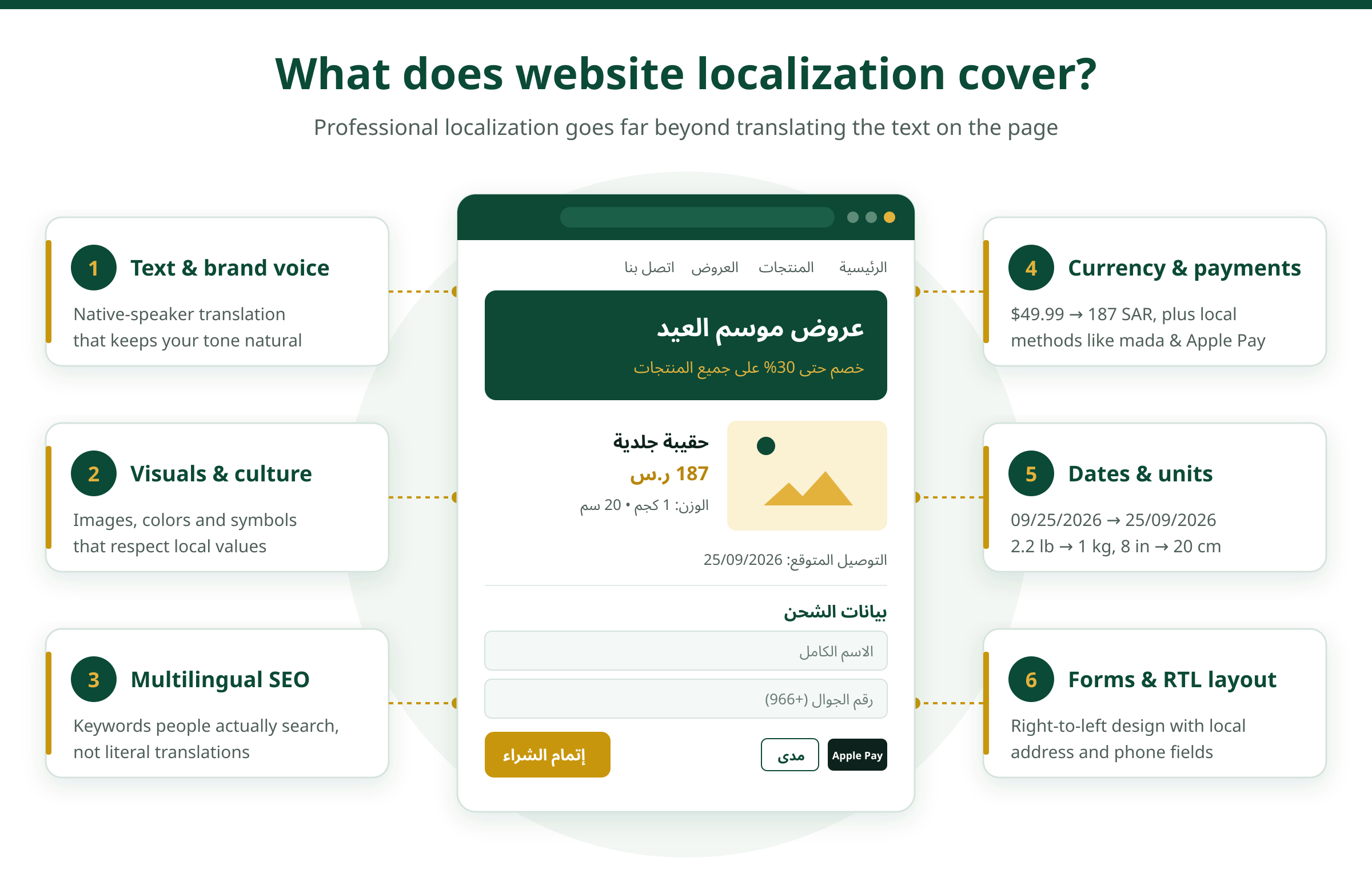
Website localization requires more than a simple translation agency. It involves translation, localization, cultural adaptation, and localization quality assurance (LQA) to ensure the target audience understands, responds to, and trusts the brand.
Here are some questions to ask when choosing professional website localization services in 2026:
1. Does the Service Deliver Only Translation?
For website localization, translation is not enough. The website needs localized content, visuals, and multimedia that reflect the target audience’s preferences.
For example, brands localizing their websites for the MENA region should respect local traditions and religious values to gain the audience’s trust. This goes far beyond traditional translation.
2. Does the Service Rely on Native Speakers and Linguistic Experts?
In localization, brands should always choose native-speaking translators. They deliver accurate translations while preserving the brand’s tone and message in the target language, without unfamiliar or awkward phrasing.
Some websites, such as technical, medical, and legal websites, require deeper domain expertise and the right terminology in the target language. That is why linguists and subject-matter reviewers are vital when accuracy and compliance matter.
3. Does the Provider Have Experience in Your Industry?
Different website types require different localization processes and present different challenges. Brands should ask for a portfolio of websites in the same industry and review the types of projects the provider has worked on.
Corporate websites require extra attention to legal compliance, resources, clear mission and vision statements, and downloadable documents. E-commerce websites focus more on UI, product descriptions, checkout processes, and revenue, ensuring an easy purchasing experience in the target language.
4. Does the Provider Offer Cultural Adaptation?
Cultural adaptation is a vital part of professional website localization services. The website should look as if it was created for the target audience rather than simply translated.
Cultural adaptation covers colors, images, and symbols while remaining sensitive to taboos and cultural red lines.
5. Does the Service Include Localization Quality Assurance?
Professional website localization services should ensure both translation accuracy and localization quality. This includes proofreading and revision by native speakers and experts, as well as testing links, forms, and multimedia after localization to verify that every localized element works properly.
6. Does the Provider Hold Quality Certifications?
Brands looking for professional website localization services should check for quality certifications such as ISO 17100 for translation services and ISO 27001 for information security management.
Why Choose Saudisoft for Professional Website Localization Services?
With more than 40 years of experience and support for 100+ languages, Saudisoft has the expertise to deliver high-quality professional website localization services.
Our services go beyond translation to deliver real localization. With our native Arabic speakers, we have helped hundreds of international brands enter MENA markets across many industries, and our cultural adaptation services ensure the target audience can trust the localized website.
Saudisoft is ISO 27001 and ISO 17100 certified, giving our clients confidence that our translation and localization services meet internationally recognized standards.
Ready to Enter the MENA Market?
Whether you are entering these markets for the first time or scaling your presence across more Arabic dialects, we have the experience, technology, and expertise to provide the professional website localization services your business needs. Contact us now.