RTL Design for Arabic Websites: A Practical Checklist
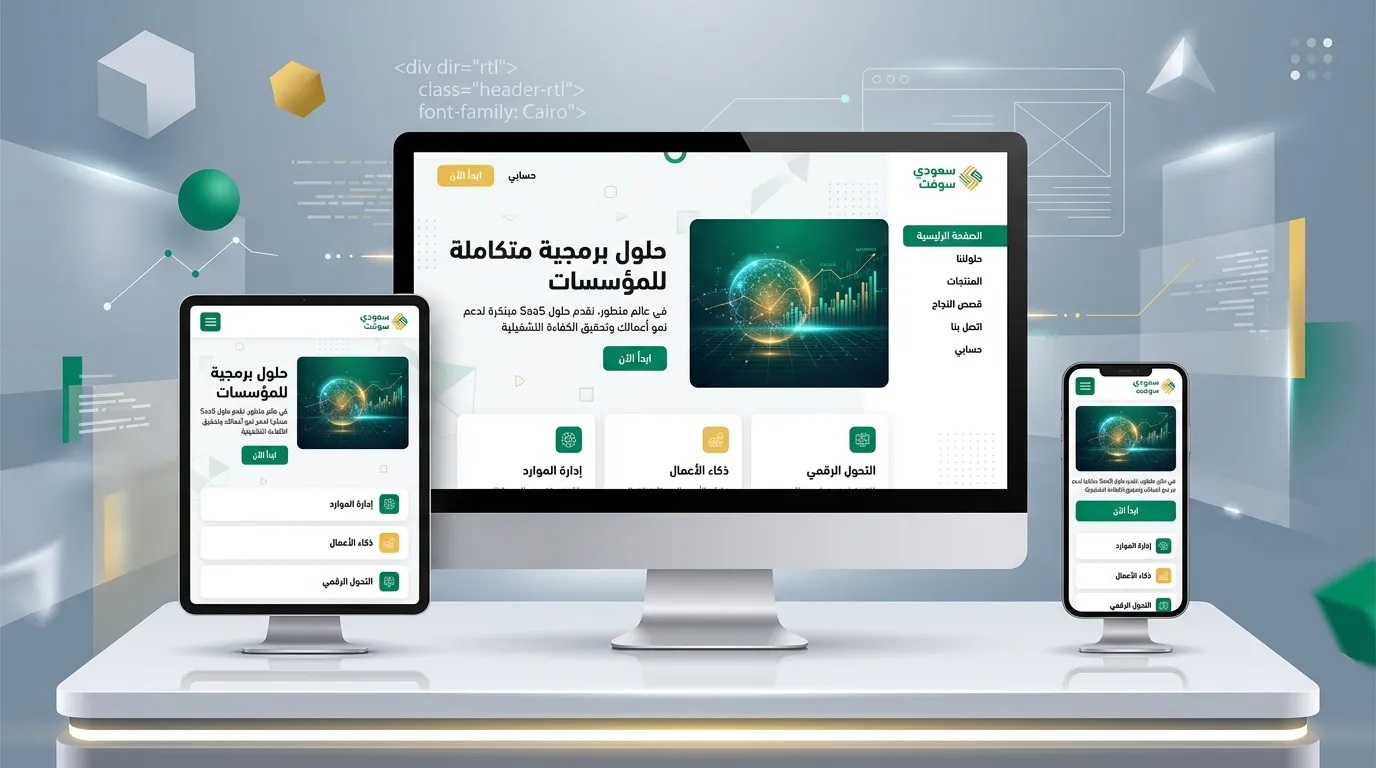
 Direct Answer: Successful RTL design for Arabic websites requires mirroring layouts, aligning navigation to the right, using scripts optimized for Arabic typography, flipping directional icons, and handling bidirectional (BiDi) text to create an intuitive experience for native speakers.
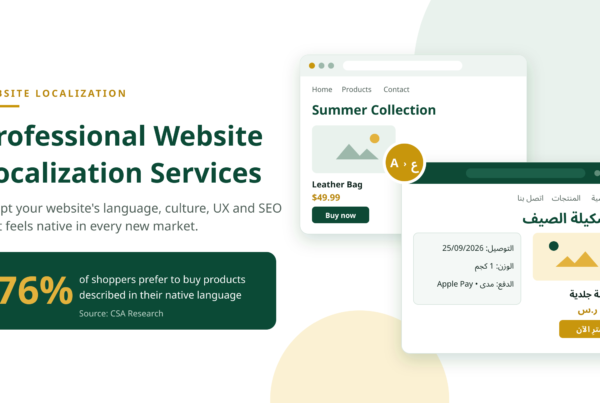
Launching a website in Arabic involves more than just translating your content. Since Arabic is a right-to-left (RTL) language, it requires a complete restructuring of your interface—including layout, navigation, typography, and icons—to ensure it feels intuitive for Arabic-speaking users. Failing to do this can create confusion, diminish trust, and lead users to leave before engaging with your content.
This comprehensive 2026 checklist covers every critical aspect of RTL design, providing the technical context you need to understand why each step matters.
What Is RTL Design and Why Does It Matter?
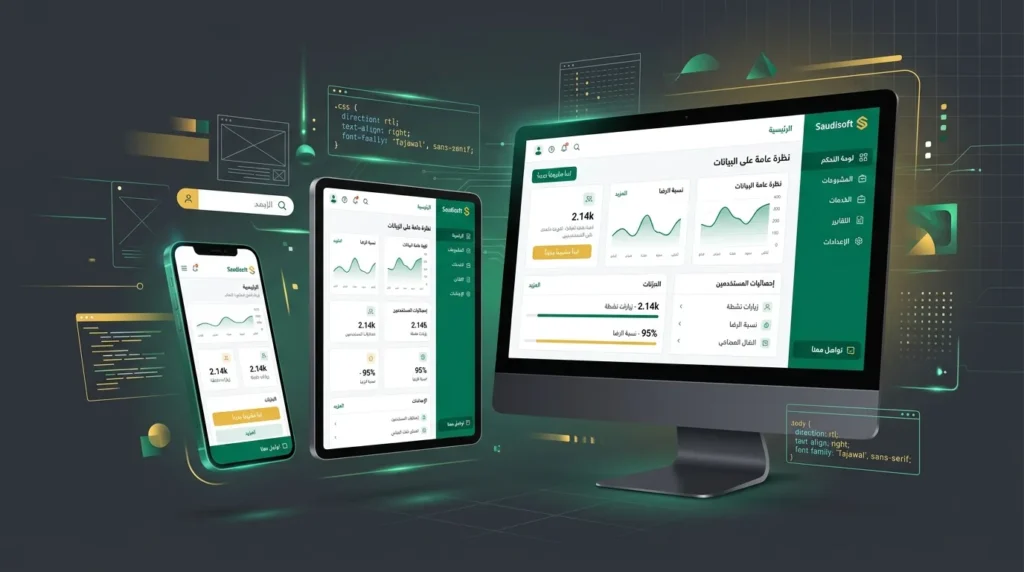 RTL (Right-to-Left) design involves modifying a digital interface so that its reading direction, visual hierarchy, and layout flow from right to left, which is the natural orientation for Arabic script.
With over 400 million Arabic speakers across 22 countries, the Arab world stands as one of the fastest-growing digital markets. Recent 2026 market statistics indicate that online services and e-commerce platforms in Saudi Arabia, the UAE, and Egypt generate hundreds of millions of dollars in annual revenue. Yet, many global businesses enter these regions with websites that feel misaligned because they treat Arabic localization merely as a translation task rather than a core design requirement.
A proper RTL implementation directly improves:
- User Trust: A layout that contradicts the reader’s natural sight-line signals a lack of attention to detail.
- Usability: Menus, forms, and core content flow seamlessly according to how Arabic speakers naturally interact with technology.
- Conversion Rates: Eliminating misaligned interfaces directly reduces user drop-off during the checkout and browsing journeys.
- SEO Rankings: Correct HTML direction attributes and clean Arabic language code structure significantly improve visibility in regional search engine results.
The Core RTL Design Checklist
 1. Set the HTML Direction Attribute
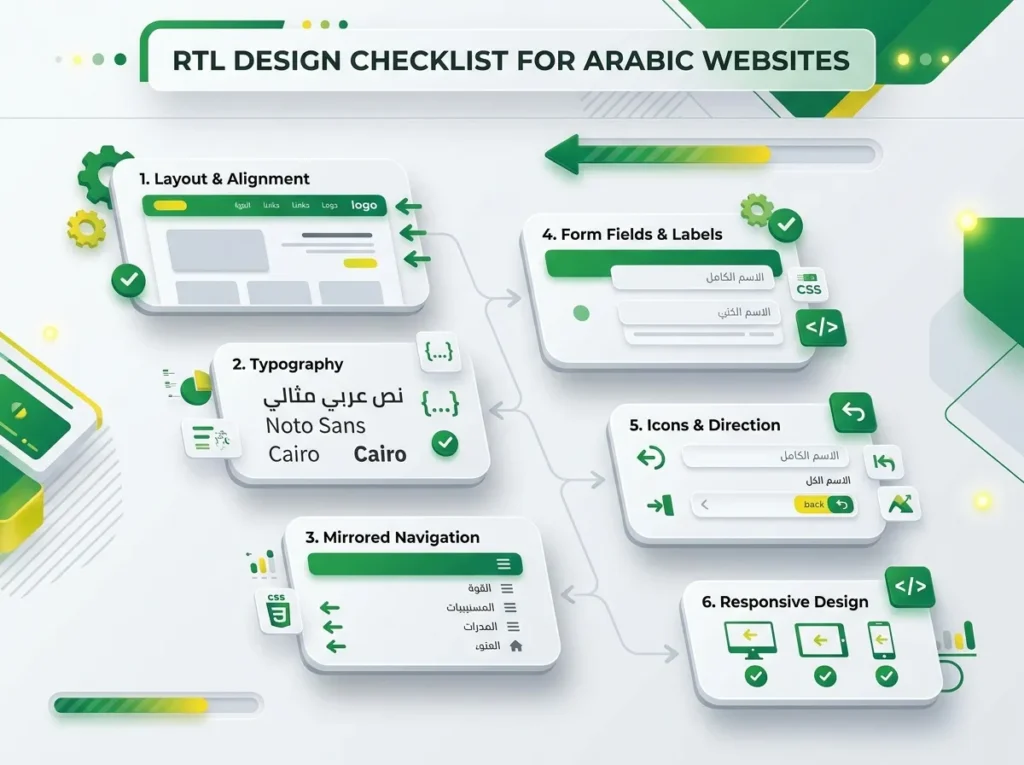 1. Set the HTML Direction Attribute
The first and most fundamental step is declaring the page direction in your HTML by adding the dir="rtl" and lang="ar" attributes to the <html> tag. This single attribute triggers the browser’s built-in RTL rendering across text, inputs, and layout blocks. The language attribute helps search engines, screen readers, and automated browsers correctly parse your content.
2. Mirror the Page Layout
In LTR (Left-to-Right) design, the eye enters from the top-left. In RTL, it enters from the top-right. Your grid must reflect this shift:
- Sidebars must shift from left to right.
- Primary content columns must anchor securely to the right side.
- Page headers, footers, and section introductions must align to the right.
- Visual hierarchy should build cohesively from right to left.
3. Adapt Navigation and Menus
Your platform’s navigation must be fully mirrored to avoid disorienting the native user:
- The company logo moves to the top-right corner.
- Main navigation menu links align directly to the right.
- Dropdown sub-menus must open toward the left.
- Breadcrumbs read right to left (the homepage anchor sits on the far right).
- Mobile hamburger menus move to the top-left (mirrored from their typical LTR position).
4. Use Arabic-Appropriate Typography
Font choice heavily influences readability and brand authority in Arabic. Keep these rules in mind:
- Use fonts designed specifically for the complex Arabic script, such as Cairo, Tajawal, Noto Sans Arabic, or Amiri for formal contexts.
- Increase line height because Arabic characters with diacritics (harakat/tashkeel) demand more vertical space than Latin fonts.
- Arabic characters can visually render smaller than Latin letters at identical pixel values—always adjust font sizes dynamically.
- Never apply the CSS rule
text-transform: uppercaseto Arabic text; the concept of capitalization does not exist in Arabic and will break rendering. - Typography is only one part of localizing for Arabic markets — see our guide on choosing the right Arabic dialect for your business.
5. Mirror Directional Icons
Icons that communicate direction, progression, or time-passage must be flipped in an RTL interface:
- Arrows indicating “next” or “forward” must point left (←) instead of right (→).
- Progress bars must fill smoothly from right to left.
- Sliders, adjustments, and range inputs must initiate from the right side.
- Media player timelines should run right to left.
6. Handle Bidirectional (BiDi) Text
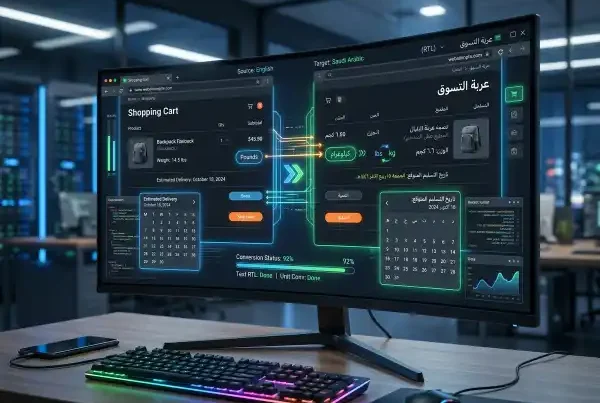
Arabic content frequently contains LTR elements like product codes, phone numbers, URLs, email addresses, and specific brand names. To prevent mixed-direction content from scrambling, apply dir="ltr" to inline elements containing Latin scripts, ensure numbers remain LTR, and utilize the HTML5 <bdi> tag around unknown user-generated inputs.
7. Adapt Visual Media and Graphics
Images carry inherent directional meaning. People in photos who are looking or gesturing toward a specific side should face right in RTL contexts. Similarly, step-by-step diagrams and infographics must be redrawn to read right to left to avoid user comprehension friction.
8. Test with Live Arabic Content
RTL bugs are often invisible until code interacts with live data. Thoroughly test rendering across major browser engines (Chrome, Firefox, Safari, Edge), test native layouts on both iOS and Android mobile browsers, and utilize real Arabic text strings instead of standard Latin Lorem Ipsum placeholders to catch layout wrapping, text truncation, or overflow issues early.
How Saudisoft Helps You Get It Right
 How
How Achieving a flawless RTL user experience requires a rare blend of linguistic precision, advanced UX engineering, and front-end development expertise. Saudisoft brings all these disciplines together under one roof:
- Arabic Localization: With over 40 years of regional experience, our native linguists specialize in Modern Standard Arabic (MSA) and localized dialects across the Gulf and North Africa to ensure your text reads organically.
- RTL UI/UX Audits: We evaluate your live codebases against a rigorous layout, typography, and interactive component checklist to streamline workflows for your development team.
- Technical Implementation Support: From deploying clean RTL stylesheets to managing bidirectional text architecture, our engineers build scalable localization frameworks.
- Contextual Quality Assurance: Native Arabic speakers review your platform live within the UI—not just in spreadsheets—to catch truncated text and rendering friction prior to deployment.
Ready to introduce a truly native experience to the Middle Eastern market? Contact Saudisoft today to launch your Arabic localization project successfully.
Frequently Asked Questions (FAQ)
1. Why is setting dir=”rtl” manually in CSS not enough for a website?
While CSS rules handle basic visual presentation, declaring dir="rtl" directly on the global HTML tag instructs the browser engine to natively adjust text alignments, form inputs, layout structures, and default element positioning consistently across all browsers and assistive technologies.
2. Should numbers be mirrored or flipped in an RTL Arabic layout?
No. Both Western Arabic numerals (1, 2, 3) and Eastern Arabic numerals (١, ٢, ٣) are read from left to right, even when embedded inside a right-to-left Arabic sentence. Forcing numbers to change direction will scramble sequences, phone numbers, and mathematical data.
3. Which icons should NOT be flipped in an RTL design?
Icons representing universal tools, non-directional objects, or symmetrical shapes do not need mirroring. For example, search magnifying glasses, shopping carts, trash cans, and envelopes should remain unmirrored unless they imply a distinct directional flow or progress timeline.