Localization in Saudi Arabia
Localization vs. Translation: What KSA Businesses Actually Need
 In a world where people are constantly overcoming language barriers, effective communication across sectors and industries has never been more critical. In the MENA region—and especially in the Saudi Arabian market—investors and companies are increasingly expanding their presence to capitalize on emerging opportunities. As a result, translation and language solutions have become essential. But what does the Kingdom’s business landscape really need: translation alone, or the more advanced approach of localization?
What Is the Difference Between Translation and Localization?
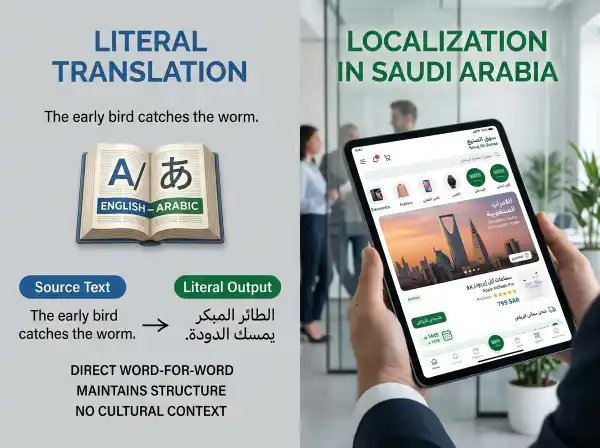
 When we talk about translation, we are referring to converting content from one language to another while ensuring it remains clear and understandable and conveys the same message. But have we considered whether that message truly resonates with the target audience? That is where localization comes in.
Translation, in its simplest form, is the process of converting content into another language while preserving its meaning and clarity. This works well for instruction manuals, technical documentation, and product descriptions, where cultural adaptation is often less critical.
Localization goes beyond linguistics. It is about adapting the entire experience—not just the message—so that every website, piece of content, or application feels as though it was created specifically for the target audience.
For example, if you operate an e-commerce website in the United States and plan to enter the Saudi market, you need to localize the content, not simply translate it. The United States uses the customary system of measurement, so if a product description states that it is suitable for someone weighing 50 pounds, an American audience will immediately understand the reference. A Saudi customer, however, is more familiar with the metric system, meaning that measurement should be converted into kilograms.
The same principle applies to colors. In many East Asian cultures, white is associated with mourning and sadness. In Arabic culture, however, white symbolizes purity, hope, and peace, and is often associated with positive occasions such as weddings. A brand that overlooks this distinction risks communicating an unintended message to its audience.
Why Translation Alone Is Not Enough for the Saudi Market
Beyond units of measurement and color symbolism, localization in Saudi Arabia affects every layer of the customer experience. Date formats, payment methods, right-to-left (RTL) text layouts, and even the visual cues that establish trust differ significantly between Western and Saudi markets.
A checkout page that feels intuitive to an American user may feel unfamiliar or less trustworthy to a Saudi customer—not because the language is incorrect, but because the experience itself has not been adapted to local expectations. This is why businesses entering the Saudi market that rely solely on translation often experience lower conversion rates despite having technically accurate Arabic content.
Saudi Arabia’s Commitment to Arabic: The National Language Policy
Saudi Arabia is actively strengthening the role of Arabic across all sectors. In February 2026, the Kingdom’s Council of Ministers approved the National Policy for the Arabic Language under Resolution No. 588—one of the most significant language reforms in the country’s history.
The policy reinforces Arabic as the Kingdom’s primary language and strengthens its presence in education, media, business, and cultural life. It also requires public-sector entities, private-sector organizations, and non-profit institutions to use Arabic in contracts, certificates, commercial signage, invoices, advertisements, conferences, and seminars.
The National Policy for the Arabic Language is not merely a cultural initiative—it carries substantial commercial implications. For foreign companies operating in Saudi Arabia, producing high-quality, culturally appropriate Arabic content is no longer optional; it is a matter of compliance, credibility, and customer trust.
Businesses that view this requirement as a localization investment rather than a translation expense will be better positioned to build strong relationships with Saudi partners, regulators, and consumers.
What Do Businesses in Saudi Arabia Really Need?
 The answer depends on the type of content and its intended purpose. Technical documentation, legal contracts, and product manuals often require highly accurate translation and consistent terminology management. However, customer-facing content—including websites, applications, marketing campaigns, social media content, and customer support experiences—almost always requires full localization.
The most successful brands in the Kingdom are those that make Saudi users feel seen, not just understood. In a market as culturally unique and rapidly growing as Saudi Arabia, localization is not a premium option—it is the baseline requirement for meaningful market entry.
Saudi Arabia’s Vision 2030 has also expanded the scale of opportunity. According to the Saudi Arabia Venture Capital Report 2025, the Kingdom accounted for 45% of the total venture capital investment value in the Middle East and North Africa (MENA) region in 2025, up from 32% in 2024, with a total of 257 deals recorded. This growth continues to attract businesses from around the world.
With this level of international competition, the brands that invest in genuine localization will be the ones that earn lasting trust from Saudi consumers and business partners alike.
Ready to Localize for Saudi Arabia? Partner with Saudisoft.
You now understand the difference between translation and localization—and why the Saudi market demands more than words on a page.
For over 40 years, Saudisoft has helped businesses across industries transform foreign content into fully localized experiences that Saudi customers trust. With deep expertise in the Arabic language, cultural adaptation, and industry-specific terminology, Saudisoft is the partner that turns market entry into market success.
Start your localization journey with Saudisoft today.