Game Localization Services: A B2B Buyer’s Guide for Studios Scaling into New Markets
Video games are one of the most profitable sectors, generating enormous revenue, as many studios and publishers in USA produce many games every year, and they plan to expand into new markets through game localization into many languages, since immersion is the key to game success; when players find the game in their native languages, they like the game and become more loyal to it. In this article, we will explore what game localization services include and how they affect revenue.
What are Game localization services?
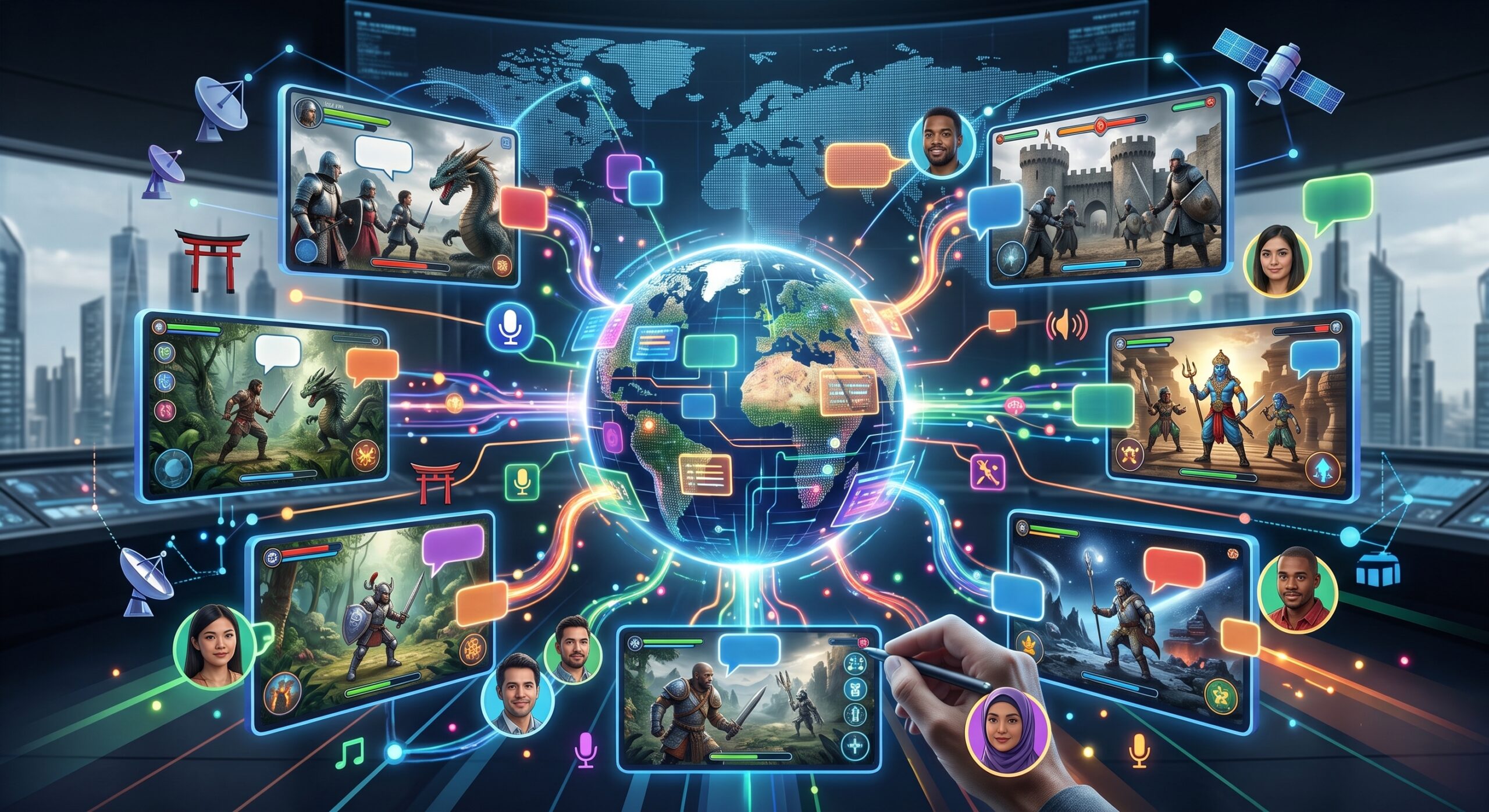
When publishers or studios search for “game localization services,” they are looking for more than a company that can translate their game into a target language; they are looking for a localization partner to localize the whole game. Localization includes many factors, from UI, UX, in-game dialogue, voice-over, LQA, and player community expressions. All these elements are adapted to align with the target audience’s language and culture, avoid misunderstandings or offense, and gain maximum support from players to achieve success in the new market.
This process makes a difference for every game, since translation alone is no longer enough given the high level of competition in the gaming market. Game localization services become essential for reaching international markets and expanding a game’s global reach.
Why do game localization services matter?
Dashboard: global gaming market stats and MENA-3 localization revenue growth from 2024 to 2025
Global market (2026)
$564.27B
Players worldwide
3.32B
Use English as UI
39.61%
MENA-3 gamers
72M+
MENA-3 games revenue, $B (Saudi Arabia, UAE, Egypt)
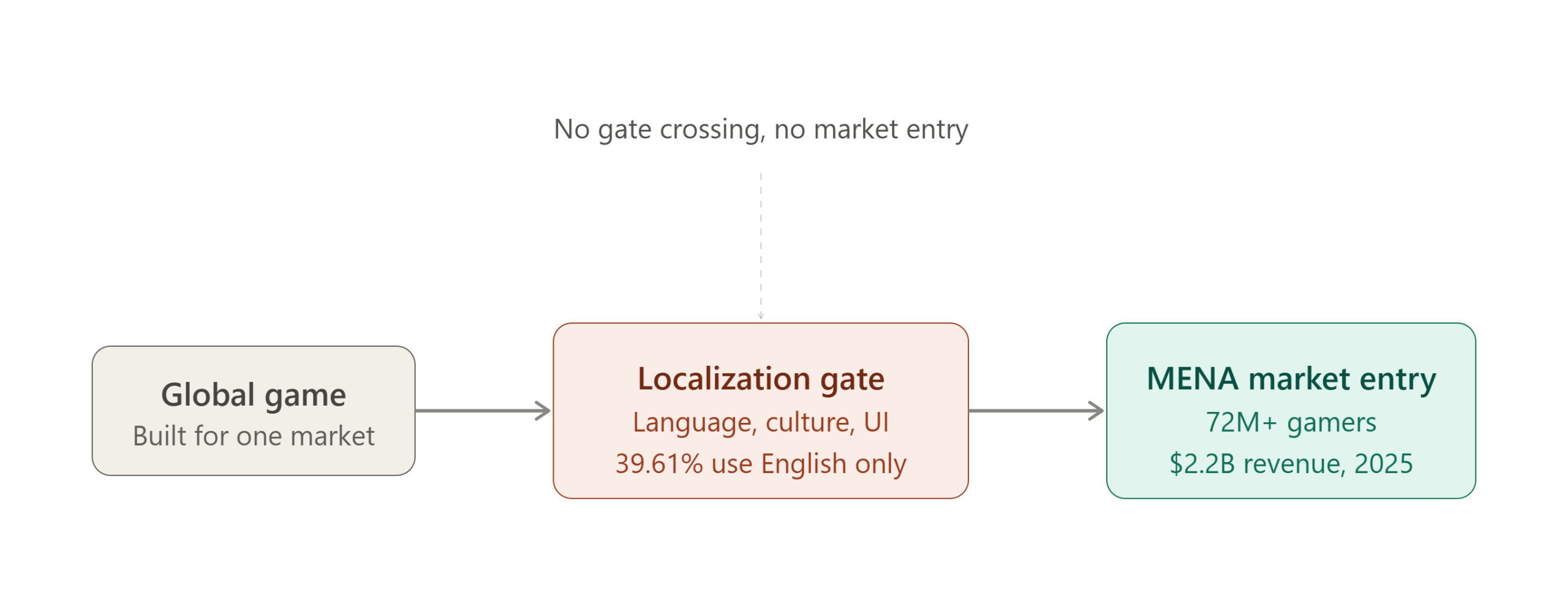
Gaming market revenue worldwide is projected to reach $564.27 bn in 2026. With over 3.32 billion players worldwide, localization is no longer optional, as immersion is more meaningful when players interact in their native language, with localization games can reach more people, while publishers can demonstrate that they value players who do not speak their language, helping build stronger loyalty toward game and brand and game, in addition to, Asia have the largest players base who don’t speak English, while only 39.61% of users use English as UI language, so the less you localize, the more revenue opportunities lose
The opportunity is especially strong closer to home: the MENA-3 region (Saudi Arabia, UAE, and Egypt) generated $2.0 billion in games revenue in 2024, up 5.4% year-on-year, with revenue expected to reach $2.2 billion in 2025 across a base of over 72 million gamers, according to [Niko Partners](https://nikopartners.com/the-future-of-gaming-in-mena-3-understanding-the-opportunity/). For studios scaling into the region, that growth makes professional game localization services a revenue driver, not just a checkbox.
Gaming market revenue worldwide is projected to reach $564.27 bn in 2026. With over 3.32 billion players worldwide, localization is no longer optional, as immersion is more meaningful when players interact in their native language, with localization games can reach more people, while publishers can demonstrate that they value players who do not speak their language, helping build stronger loyalty toward game and brand and game, in addition to, Asia have the largest players base who don’t speak English, while only 39.61% of users use English as UI language, so the less you localize, the more revenue opportunities lose
The opportunity is especially strong closer to home: the MENA-3 region (Saudi Arabia, UAE, and Egypt) generated $2.0 billion in games revenue in 2024, up 5.4% year-on-year, with revenue expected to reach $2.2 billion in 2025 across a base of over 72 million gamers, according to Niko Partners. For studios scaling into the region, that growth makes professional game localization services a revenue driver, not just a checkbox.

Elements of Game localization services?
- UI &UX: design and layout are critical for the localization process, as adapting for new market or language may require significant adjustment, for instance, English and Arabic have different text lengths. When studios or publishers translate their game into English, they have to adjust the layout for text expansion, resizing the buttons to align with the new language’s letter size and length.
- Game dialogue and text: This is one of the first phases of Game localization services. This includes translating the full range of in-game text, from menus and item names to character dialogue and subtitles in the target language.
- Visual Elements: localizing photos, symbols, and colors is vital to a successful localization strategy, as elements acceptable in an American game could cause cultural misunderstandings or even lead to rejection in the MENA region or other markets. For instance, when the creator of the American game “Crash Bandicoot” wanted to publish it in Japan, Japanese executives at “Sony” didn’t approve of the main character’s style, so they asked the American creator to modify it in order to align better with Japanese animation and avoid rejection from Japanese players who were familiar with and loved anime.
- Sounds and voices: this includes translating dialogues, orders, and instructions, and using local artists and voice talents for dubbing
- Cultural Adaptation: understanding the culture of target audience is a critical to game localization, if a publisher ignored the cultural sensitives or traditions, the localization can be a waste of time and money, and the result is disappointing and upsetting experience for players, for example “Honor of Kings” is a Chinese multiplayer online battle game, when it was localized for release in USA, it’s name was changed to “Arena of Valor” with superheroes characters such as superman and spiderman, since the united states doesn’t have the same royal history or kingdoms as China. This also includes idioms, humor, and jokes
- Legal Compliance: if a game ignores local laws and regulations, there’s no chance to achieve success, and these laws vary from country to another, for example “super Mario kart” characters celebrated winning by drinking champagne, when the game published for an American audience, Nintendo of America changed this by having the characters wave the bottle instead, since they restricted to use the alcohol for games that children play
- Marketing Materials: once game localization is complete, marketing materials like mobile store, trailers and promotional content also need to be localized
- LAQ: To ensure that your game is ready for the target market, it should pass the linguistic test to ensure the accuracy, grammar, and terminology, as well as functional testing to identify issues that could disrupt the player experience.
These elements form the foundation of game localization services; if any of them aren’t localized to a high standard, they can impact the entire localization process negatively and reduce the game’s chances of success across target languages and markets.
Challenges of Game Localization Services

- Text length and UI design: when translating from language to another, formatting may be change, and the translated text may require more space than the original version, for example, German translation can cause over-flow fixed UI, as a result the UI element’s conflict.
- Coding: Coding mistakes during game localization can cause problems that players notice right away, like seeing strange symbols instead of text: “���”. This usually points to a character encoding issue, meaning the game can’t read or display certain characters correctly. A similar problem can happen with fonts. If a font doesn’t support the characters needed for the target language, players may see empty boxes instead of text:
But coding issues in localization don’t stop at encoding and fonts. There are two other common problems:
- Hardcoded strings: When text is written directly into the code instead of being placed in separate files for translation. This makes it harder for translators to access and translate the text.
- String concatenation: When a sentence is built by combining separate pieces of text in the code. This may work fine in English, but it can create incorrect sentences in languages with different word orders.
- Voice and audio localization: as one of the most expensive phases of game localization services, voice acting plays a critical role in a game’s success, requiring the selection of voice talent with the same age, tone, and personality to deliver the original character traits and emotions without missing any detail. Dubbing also depends on this, as one of the main causes of lip-sync failure is differences in line length between languages; for example, Japanese lines tend to be shorter than their English equivalents.
- Target language and audience understanding: when game publisher make the decision to localize their game, target audience understanding is not optional, publishers need to know very well, who their audience is, how they talk and what they except from the localized version, the same applies for target language, since localization is an significant investment, target languages should be chosen carefully, as not every language can justifies the cost, for example, according to Exploring Topics, Asia has the majority of players worldwide with 1.48 billion gamers out of 3.32 billion worldwide in 2026, so localizing into Chinese, Japanese is an opportunity to enter markets with high purchasing power.
- Lack of time: time is one of the biggest challenges in game localization services, when it comes for launch or LQA, very often, LQA take place at the end of the developments process, leaving limited time for review, especially if there’s delay in the roadmap. Timing also matters in delaying, because delaying a launch means additional costs, and every update requires new content to be localized as well, in addition, players now prefer sim-ship (simultaneous worldwide shipping) so any delays in certain regions can put a game at a competitive disadvantage.
Why is Saudisoft your partner for game localization services in MENA?
Publishers and game developers in the US know that the Middle East is a promising market for video games, with growing government attention to players, publishers, and gaming companies through initiatives such as Saudi Vision 2030. Through the years, we’ve helped launch many games, including special AAA titles, covering everything from cultural assessment, translation and localization, voice-over and subtitling, to reach the game localization test to ensure the game works well, and quality assurance to creating content that appeals to new audiences while retaining its original meaning. Ready to take your game to MENA markets? Get a quote for our game localization services today.