Arabic is not a single language for localization. It consists of a formal written standard and several regional Arabic dialects, which can differ significantly. While Modern Standard Arabic is suitable for contracts across all markets, using it in a Saudi advertisement may sound overly formal, and in Egypt, it may fail to resonate. Many international brands recognize the need to select the appropriate variety for each channel and market only after costly errors.
The Arabic content market is large but underserved. Approximately 491 million people speak Arabic across 22 countries, making it the fourth most used language online. MENA’s online shopping market is projected to reach $50 billion in 2026, according to a 2026 overview of Arabic-speaking countries. However, only about 2 percent of global marketing content is in Arabic. Well-localized Arabic content generates 35 to 50 percent more engagement than direct English translations in Gulf markets, based on 2026 GCC content marketing data.
This guide outlines when to use Modern Standard Arabic, when to use a regional dialect, and how to make these decisions based on channel rather than routine.
Why Arabic Isn’t One Language for Localization Purposes
Linguists describe Arabic as diglossic, meaning speakers use two distinct forms depending on the context. Modern Standard Arabic, derived from Classical Arabic, is the formal standard taught in schools and used in news, contracts, and official communications throughout the Arab world. In daily life, people use regional dialects, which can vary by country and even by city.
Neither form is superior; each serves a distinct purpose. Relying solely on Modern Standard Arabic for all content, regardless of audience or channel, often results in messaging that is accurate but disconnected from readers.
Modern Standard Arabic: When Formal Arabic Is the Right Call
Modern Standard Arabic is understood throughout the Arabic-speaking world. It is the preferred choice when consistency and legal accuracy are required, such as for terms of service, privacy policies, regulatory disclosures, press releases, and content for corporate or investor audiences. It is also the safest option for websites serving multiple Arab markets, as a dialect from one country may not be appropriate in another.
We apply this approach to software localization in MENA as well. Formal user interface text and support documents remain in Modern Standard Arabic, while marketing and conversational content are adapted to the local dialect of the target market.
The Major Regional Dialect Groups You’ll Localize Into
Regional Arabic dialects are categorized geographically, though significant variation exists within each group:
- Egyptian Arabic, widely recognized across the Arab world thanks to decades of film and television, and often the most broadly understood dialect outside its own borders
- Levantine Arabic, spoken across Lebanon, Syria, Jordan, and Palestine, with strong presence in regional media and conversational content
- Gulf Arabic, covering Saudi Arabia, the UAE, Kuwait, Qatar, Bahrain, and Oman, itself made up of distinct varieties such as Najdi and Hijazi within Saudi Arabia alone
- Maghrebi Arabic, spoken across Morocco, Algeria, and Tunisia, and distinctive enough in vocabulary and pronunciation that it’s sometimes only partly intelligible to speakers from other regions
These groups should not be treated as single, interchangeable dialects. For example, while Saudi, Emirati, and Kuwaiti audiences are all part of Gulf Arabic, a campaign tailored to one may not be effective for the others.
Matching Dialect to Channel, Not Just Market
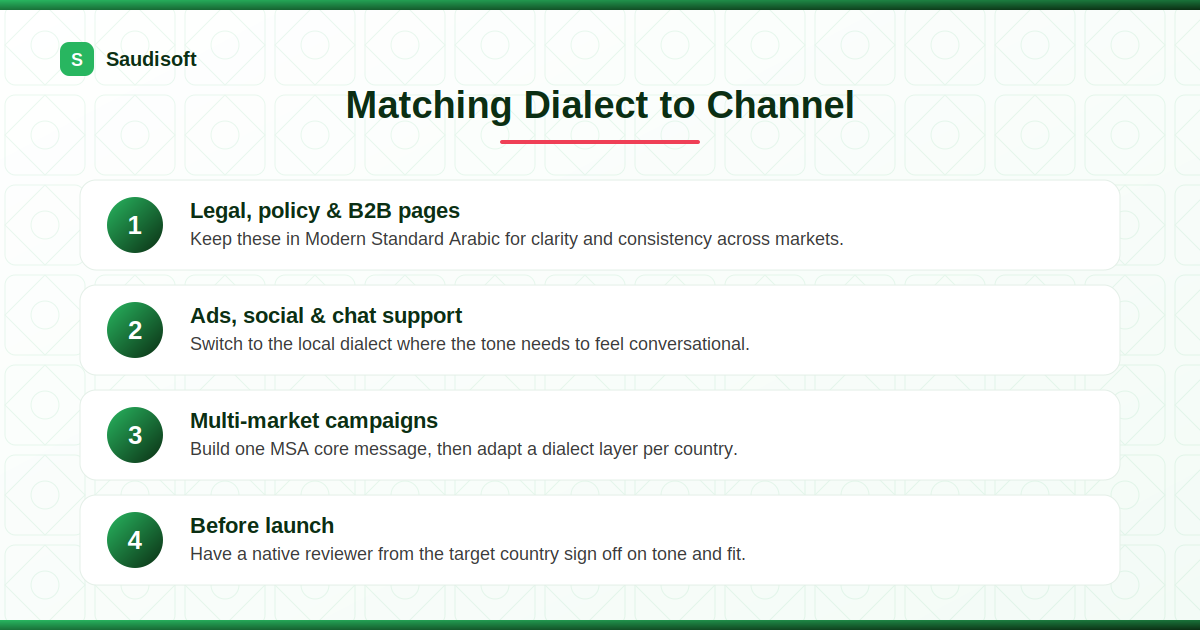
The target market determines which dialect to consider, but the channel dictates whether to use it. Gulf consumers prefer Arabic, with 68 percent favoring Arabic content over English, and Arabic content achieving approximately 2.5 times more engagement, according to a 2026 Google/Kantar-backed review of Middle East digital marketing. Social captions, ad copy, chat support, and onboarding messages are most effective in the local dialect, as this aligns with how people communicate directly.
Legal pages, compliance disclosures, and B2B materials are different. Use Modern Standard Arabic for these, and let the dialect handle conversational content like ads, community management, in-app notifications, and influencer or creator posts.
Where Egyptian and Gulf Arabic Diverge in Practice
Our linguists work daily with both Egyptian and Gulf Arabic, and the differences extend beyond vocabulary. Tone, pacing, and levels of directness vary between dialects. For example, a phrase that feels warm and casual in Cairo may seem too informal in Riyadh, where a more respectful tone is expected in customer communications. Conversely, Gulf-style wording can appear stiff to Egyptians, who prefer a faster, more playful style. As a result, a single “Arabic” campaign across GCC and North African markets typically underperforms compared to versions tailored for each dialect group.
Common Dialect Mistakes That Cost Engagement
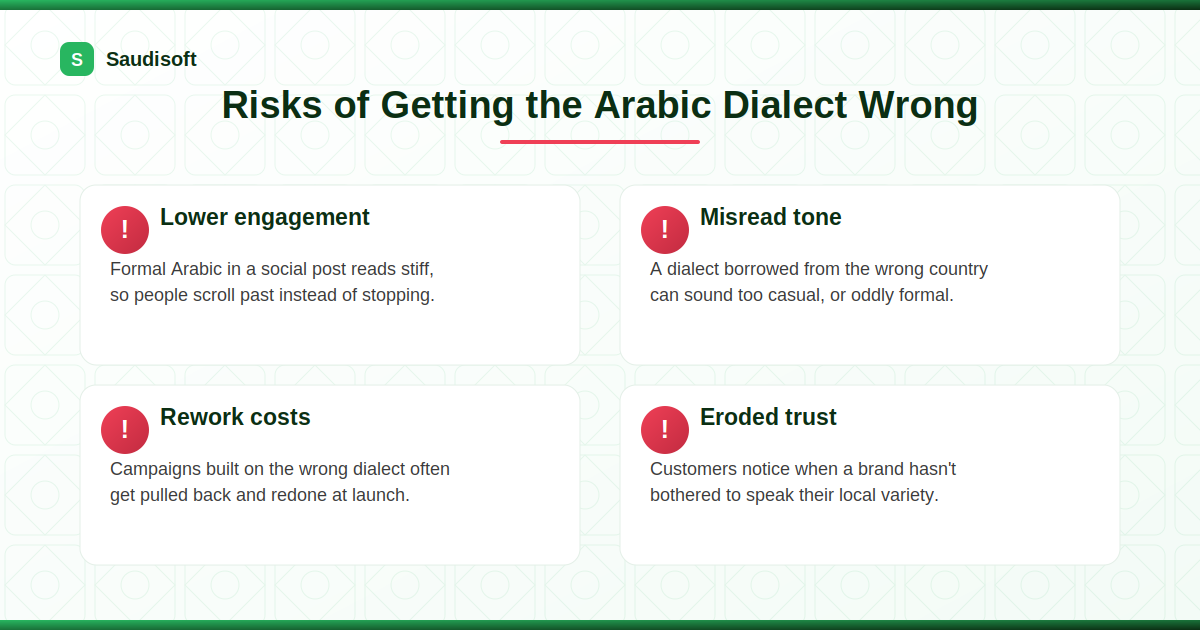
We frequently encounter similar issues when reviewing multilingual sites and campaigns in the region. These challenges align with the common pitfalls highlighted in our localization mistakes roundup:
- Using Modern Standard Arabic for social and conversational content because it feels like the “correct” or safest choice, when the dialect would perform better
- Applying one Gulf dialect, usually Saudi or Emirati, across the whole GCC without adjusting for country-specific vocabulary and tone
- Running Egyptian Arabic creative in Gulf markets because it’s widely understood, rather than because it’s the right register for that audience
- Translating a campaign into a dialect without a native reviewer from that specific country checking tone, slang risk, and cultural fit before launch
A Simple Framework for Deciding MSA vs. Dialect
Most decisions can be addressed with two questions.
First, what is the content type: formal, regulatory, brand-focused, or conversational, promotional, or support-related?
Second, who is the target market: a specific country or the entire Arabic-speaking region?
Use Modern Standard Arabic for formal content targeting the whole region. Use the local dialect for conversational content aimed at a single country. Formal content for one country can generally remain in Modern Standard Arabic unless your brand voice relies on a local tone.
For conversational content intended for the entire region, begin with a Modern Standard Arabic message and adapt it for each market, rather than using a single dialect everywhere.
Frequently Asked Questions
Should my website use Modern Standard Arabic or a regional dialect?
Use Modern Standard Arabic for your main website. It is understood across all Arabic-speaking markets and ensures consistency for legal and product pages. Dialects can be used in chat widgets, promotional banners, or landing pages for specific countries when running local campaigns.
Is it worth localizing separately for Saudi Arabic versus Egyptian Arabic?
For conversational or performance marketing content, it is generally worthwhile to localize separately for Saudi and Egyptian Arabic. Content written in the appropriate dialect, rather than just in Arabic, achieves 35 to 50 percent higher engagement than English in Gulf markets. Our Arabic marketing translation guidance details how we select the right dialect based on product, audience, and market.
Can one Arabic translation serve every MENA market?
For formal, legal, or regulatory content, Modern Standard Arabic is appropriate. However, for marketing, social, and support content, a single version is often less effective, as dialect differences influence how natural and trustworthy your content appears in each market.
How common is properly localized Arabic content right now?
Properly localized Arabic content remains uncommon. Only about 2 percent of global marketing content is written in Arabic, and even less is adapted by dialect. This presents a significant opportunity for brands willing to invest in effective localization rather than relying solely on machine translation.
Final Thoughts
Choosing between Modern Standard Arabic and a regional dialect is more than a stylistic decision. It determines whether your content feels tailored to your audience or simply translated. For further details on localizing for Gulf, Levantine, and North African markets, refer to our guide to Arabic localization for the Middle East market. Our linguists at Saudisoft work daily with both Modern Standard Arabic and major dialects. Our Arabic marketing translation services prioritize matching the appropriate language style to each market before launch, rather than correcting issues afterward.