
E-Learning Market Overview
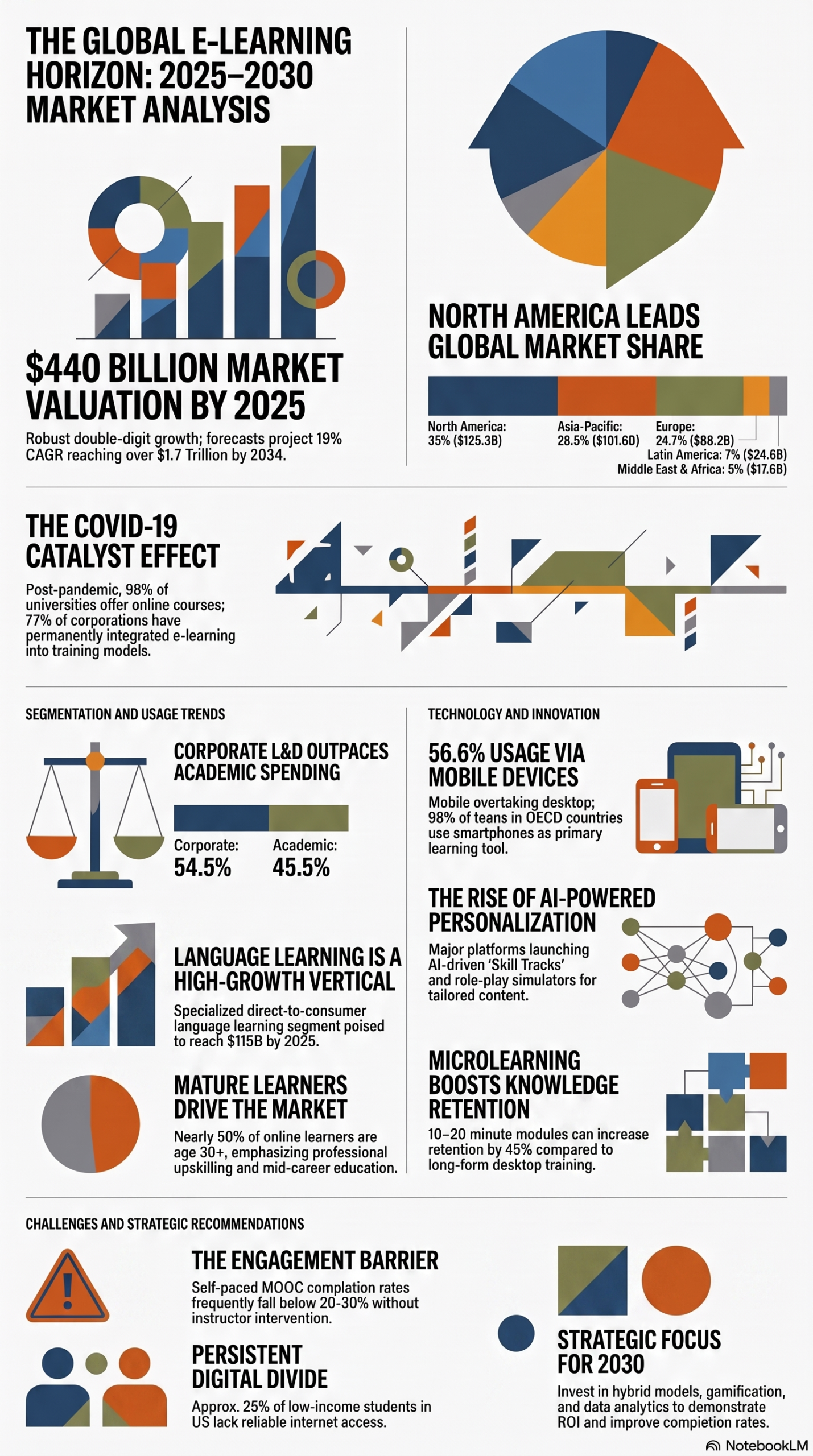
The global e-learning localization market has grown into a multi-hundred-billion-dollar industry, with 2025 estimates ranging from $357B to $440B and projected double-digit CAGR through 2030. Growth is fueled by K-12 and higher-education adoption, corporate training, and a booming language-learning segment, with academic use accounting for roughly 45–46% of the market and corporate learning and development (L&D) making up the rest. Fortune Business Insights projects the market could reach $1.71 trillion by 2034 at a ~19% CAGR.
Regional Breakdown: Where the Opportunity Lies
North America leads with roughly $125B in 2025 (about 35% share), followed by Asia-Pacific at $101.6B (28.5%) and Europe at $88.2B (24.7%). The Middle East & Africa region, while smaller at $17.0B, represents a high-growth frontier as digital education initiatives expand across the region. This is where localized e-learning content services (/services/elearning-localization) become essential for platforms entering Arabic-speaking markets.
| Region | 2025 Market Size | Share |
| North America | ~$125.3B | ~35% |
| Asia-Pacific | ~$101.6B | ~28.5% |
| Europe | ~$88.2B | ~24.7% |
| Latin America | ~$24.6B | — |
| Middle East & Africa | ~$17.0B | — |
Key Trends Driving Growth
- AI-driven personalization: Coursera and Udemy now offer AI-powered learning tracks and role-play simulations.
- Mobile-first learning: Mobile accounts for 56.6% of e-learning usage by 2025, making mobile app localization (/services/mobile-app-localization) a priority for platform expansion.
- Microlearning and VR/AR: Short-form, immersive content is gaining traction, especially in corporate training.
- Digital divide: Persistent barriers like unreliable internet access continue to limit adoption in underserved regions.
Why Localization Matters for E-Learning Platforms
With corporate L&D representing roughly 54.5% of the market and projected to grow at ~10.4% CAGR through 2031, global platforms competing for enterprise clients need content that resonates culturally and linguistically. Language learning alone is projected to reach $115B by 2025, up from $60B, showing how demand for accessible, localized content is accelerating. Companies like Babbel already use subscription and family-plan pricing models to scale across regions—a strategy that pairs naturally with localized UX and content.
For platforms eyeing MENA expansion, professional Arabic translation and localization services (/services/arabic-localization) are no longer optional—they’re a growth requirement, given the region’s rising smartphone penetration and government-backed digital education pushes.
Barriers That Localization Can Help Solve
Low completion rates in self-paced courses and the digital divide remain the sector’s biggest restraints. Localized, culturally adapted content combined with mobile-first design and human-centered support (coaches, community features) has been shown to significantly improve engagement and retention.
What This Means for E-Learning Providers
Providers expanding into new markets should prioritize AI-driven personalization, mobile and microlearning formats, and strong content localization and translation partnerships (/services/content-localization) to capture underserved regional demand. As HolonIQ notes, EdTech investment is shifting toward proven, scalable platforms rather than early-stage bets—meaning localization quality is now a competitive differentiator, not a nice-to-have.