How to Find a Qualified Translator You Can Trust
Start With the Authority’s Requirements
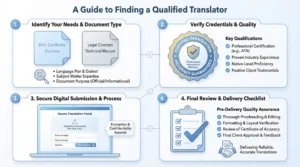
When an authority asks for a certified translation, you’re not just hiring a bilingual person — you’re choosing a provider who can deliver a faithful, complete rendering of your document and attach a signed certificate of accuracy that officials will accept without question. The smartest way to start your “near me” search is to work backward from the destination’s rules. Read the requesting body’s instructions line by line and note exactly what they require — certified translation only, or a notarized translator’s signature as well; acceptance of digitally signed PDFs versus printed originals with wet signatures and stamps; any need for an apostille or legalization of the original; the language of submission; and your deadline. Clear requirements prevent detours and help you brief providers precisely.
 Search Smart Using Trusted Sources
 Search Smart Using Trusted Sources
With that checklist in hand, search smart rather than broad. Professional directories and reputable associations let you filter by location, language pair, and specialization, which is far more reliable than generic ads. Prioritize profiles that explicitly mention certified work for immigration, courts, universities, banks, or healthcare, and confirm they can supply notarization and hard copies if needed. If your country licenses or appoints translators (often called sworn translators), consult the official roster.
Embassies and consulates sometimes publish local Qualified Translator lists that, while not endorsements, can shorten your search. Remember that proximity today is often virtual: many certified providers operate securely online — you upload high-resolution scans, receive a digitally signed certificate, and, if the institution insists on paper, they courier originals on letterhead with wet signatures and stamps. For most cases, acceptance by the receiving authority matters more than walking distance.
Verify Acceptance Before Discussing Price
As you build a shortlist, verify acceptance before discussing price. Ask each provider whether their certified translations have been accepted by your specific destination — this immigration office, court, university, or bank — and request a sample certificate of accuracy. A proper certificate includes the translator’s or agency’s name, signature, date, contact details, and a clear declaration that the translation is complete and accurate.
Confirm they can mirror the source formatting so reviewers can compare line by line: headings, tables, seals and stamps labeled in brackets, footers, and pagination. If sections of the original are illegible, a professional will mark them transparently rather than guess. If your file set shows inconsistent name spellings or dates, a diligent provider will flag those early and propose a consistent transliteration policy before certification.
Understand Certified, Notarized, and Apostilled Translations
Understanding the terms helps you order the right service the first time. A certified translation is the translation plus the signed certificate of accuracy — that’s what many authorities request. A notarized translation means a notary public verified the identity and signature of the person who signed the certificate; notarization does not vouch for translation quality.
In some countries, only government-appointed sworn translators can issue translations with legal force within that jurisdiction. Apostille and legalization refer to government authentication of a document’s origin for cross-border use; they are separate from translation but sometimes required in the same application. Your provider should explain which elements apply to your case and assemble them in the correct order.
Evaluate Quality and Security Processes
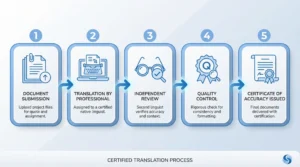 Evaluate Quality and Security Processes
Quality in certified work is achieved through process, not promises. Look for a two- or three-step workflow: translation by a Qualified Translator , independent review by a second linguist for accuracy and consistency, and a final quality control pass to confirm formatting, numbering, and certificate details.
Strong providers maintain glossaries and termbases so names, institutions, and technical terms are rendered consistently across your entire file. Because certified projects often involve sensitive personal data, ask how your documents are protected — encrypted uploads, restricted internal access, and clear retention and deletion policies are signs of a mature operation.
Responsiveness matters too: insist on a named point of contact, clear timelines, and transparent pricing to avoid last-minute surprises.
Timelines, Costs, and Practical Tips
Timelines and costs depend on page count, legibility, subject matter, and extras like notarization or shipping of hard copies. Clean, typed civil records — birth and marriage certificates, transcripts, bank letters — often turn around in one to three business days. Handwritten records, poor scans, large bundles, or specialized legal or medical files take longer.
You can control time and cost by scanning in color at 300 dpi or higher, including every page (even backs marked “blank”), confirming how names should appear in the target language, and sharing prior translations if you want spellings matched.
If you have a fixed appointment — a visa interview, court filing, or enrollment deadline — tell the provider upfront so they can plan rush service or staged delivery (digital first, hard copies later).
Final Acceptance Checklist Before Submission
Before submission, run a simple acceptance check: every page translated with no omissions; stamps, seals, signatures, and handwritten notes indicated in brackets; names, dates, and numbers consistent across all documents; the certificate signed, dated, and carrying provider contact details; notarization added if required; and, when an institution demands paper, printed originals with wet signatures and stamps packed for courier.
Handle these details once, correctly, and your documents move through review faster. That’s the real value of searching “certified translation services near me” with care: you’re not buying convenience — you’re securing a smooth path through an official process with translations that read clearly, look professional, and pass review the first time.