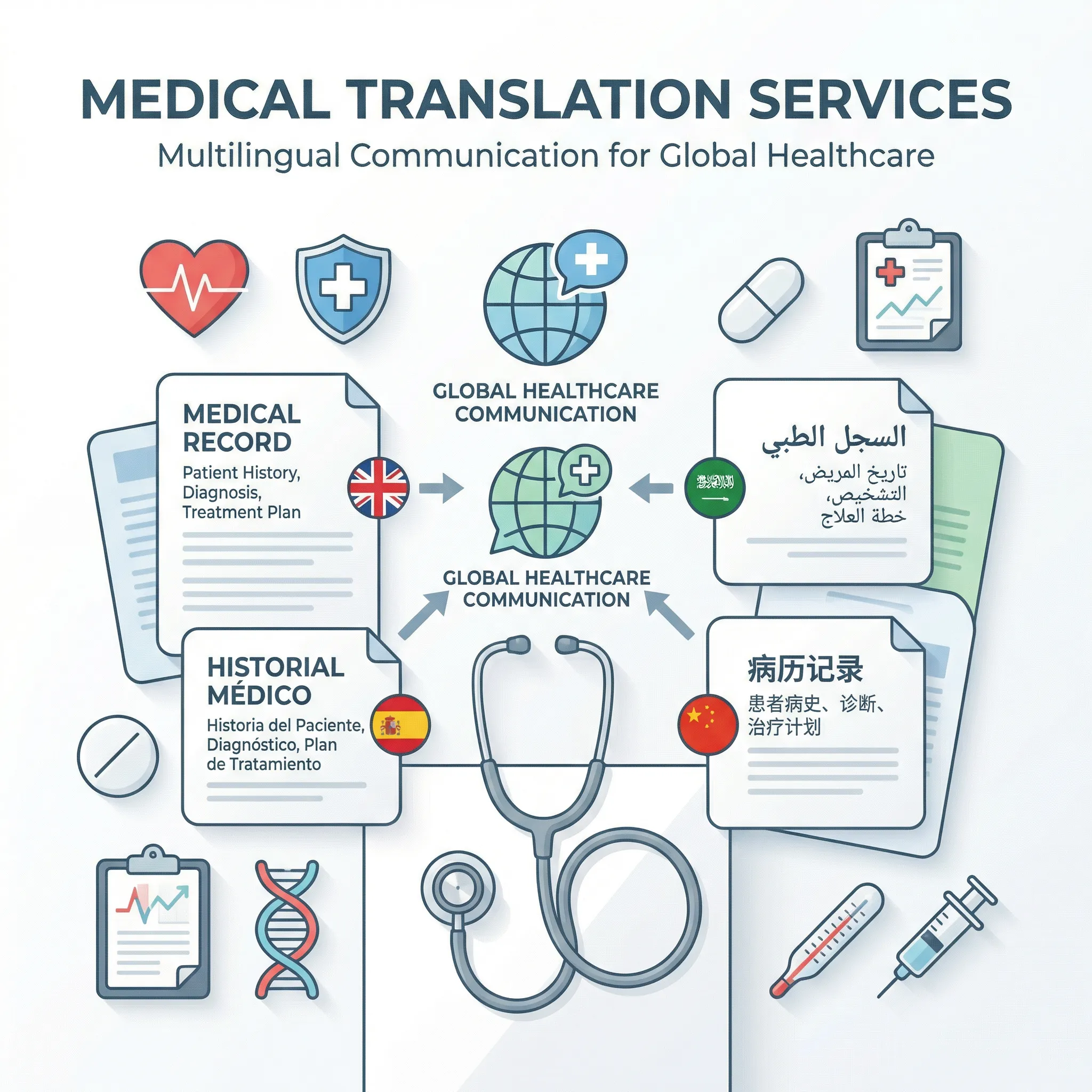
Healthcare Translation and Localization: What They Are and How They Affect People’s Lives
 With the rapid growth of technology, the healthcare sector has experienced significant advancements in services and medical devices, creating an urgent need for multilingual communication. This has further increased the importance of medical language services in healthcare. Translation in this field requires a high level of accuracy, as even a single number or piece of information can impact someone’s life.
In addition, it demands a deep understanding of medical terminology while carefully considering cultural context throughout the translation process. This ensures accurate delivery of meaning and minimizes the risk of errors that may lead to serious consequences for patient safety and lives.
This article explains the vital role of professional medical translation and localization, and how they help make healthcare accessible to people worldwide.
What is Medical Translation?
Medical translation involves transferring medical or pharmaceutical content from one language to another while preserving the original meaning. After COVID-19, the demand for international healthcare translation increased significantly, particularly for medical reports and vaccines. This period marked a new chapter and further highlighted the importance of medical translation.
What’s the Difference Between Medical Translation and Medical Localization?
While breaking the language barrier is the main goal of translation across all fields—including healthcare—medical localization, or Healthcare Localization, goes a step further. It ensures that meaning is conveyed accurately within the cultural context, giving a clear advantage over standard translation.
Medical localization also considers the characteristics of the target audience, their cultural nuances, and subtle linguistic differences, whether for healthcare professionals or patients receiving medical care.
What Are the Key Challenges in Medical Translation and Localization?
For healthcare translation services, there are many challenges that hinder the process. While other fields may require more flexibility, medical document translation requires greater accuracy. Below are the main challenges for medical translators:
Complex Medical Terminology
Medical texts contain terms that are difficult for any non-professional translator to understand and interpret. For example, the term “heartburn” literally translates to “burned heart,” which could alarm a patient, whereas its actual meaning is chest burning caused by acid reflux.
Abbreviations can also be confusing: “infl.” refers to inflammation, while “inf.” means infection.
Variations in Healthcare Roles
Professional titles and terminology differ across countries, which can significantly impact medical terminology translation. For instance, a “midwife” may have different responsibilities depending on the country.
Similarly, a surgeon in the US may perform a variety of surgical procedures, whereas in the UK, their practice might be limited to a specific type of surgery, reflecting the precise scope of their specialization.
Serious Consequences
Unlike many other industries, medical content translation services must be highly accurate, as errors can lead to real and potentially dangerous consequences.
Cultural Differences and Nuances
This is where the role of medical localization services becomes essential. Some foods recommended for treatment may be prohibited due to social or regional considerations.
The same applies to non-verbal communication; for example, in Bulgaria, shaking the head means “yes,” while nodding means “no.”
Continuous Updates
The medical field is one of the most rapidly evolving sectors. Within this context, translation and localization in healthcare strive to keep pace with ongoing developments.
How Certified Medical Translation and Localization Improve People’s Lives
Improving people’s lives involves many aspects, and one of the most important is their right to access fair and equitable healthcare. Within this context, healthcare document translation and localization play a vital role by providing access to treatment and medical awareness, regardless of a patient’s location.
Medical localization goes beyond geographical boundaries, as it enables patients of varying educational levels to understand essential information, such as medical instructions, reports, and prescriptions. Medical content is tailored for each patient, ensuring they can comprehend and act on it.
In this way, healthcare localization services are more than just services provided by public and private healthcare institutions worldwide; they represent a commitment and responsibility toward patients. This approach enhances patient engagement, improves communication with healthcare providers, increases medical awareness, and reinforces patients’ fundamental right to receive high-quality healthcare that respects and aligns with their cultural background.
How Saudisoft Ensures Equity in Access to Healthcare
Over 40 years, Saudisoft has established itself as a pioneer in translation and localization, demonstrating a high level of commitment and precision in every project. In healthcare translation, we are the leading provider of medical translation services in the MENA region, offering the best solutions for various medical needs:
- Patient prescription translation
- Medical report translation
- Pharmaceutical translation services
- Medical documents such as medical records, prescriptions, data sheets, and reports
- Patient record translation
- Clinical trial translation services and questionnaires
- Signs and brochures for hospitals
- Medical supplies (instruction manuals, brochures, and software)
- Information on clinical, toxicological, pharmacological, and biological issues
- Regulatory medical translation
As a healthcare translation services provider, Saudisoft also offers Healthcare Interpretation to enhance communication between healthcare providers and patients in hospitals, clinics, and conferences.
Medical localization is not limited to documents and pharmaceuticals; it also covers hospital and clinic websites for patient safety translation. Additionally, Saudisoft offers medical app translation, ensuring that every patient around the world has access to healthcare in their own language.
If you’re looking for the best medical translation agency with ISO-certified services, Saudisoft should be your first choice. Contact us now!