A Complete Guide to Official Document Translation
Official Document Translation — what it really is
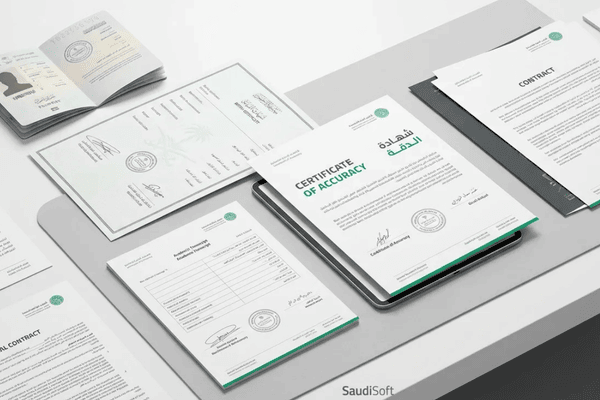
Certified translation services make official documents usable across borders and institutions. You are not just turning words from one language into another — you are producing an accurate, verifiable record that authorities can trust. A certified translation is a complete, faithful rendering of every element of a document — text, stamps, seals, signatures, tables, even handwritten notes — accompanied by a signed Certificate of Accuracy stating that the translation is true and complete.
 Certified vs. notarized vs. sworn vs. apostilled
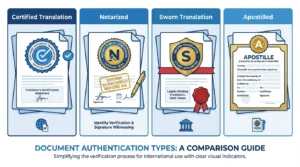 Certified vs. notarized vs. sworn vs. apostilled
A notarized Official Document Translation is not a quality seal; it is a notary confirming the identity or signature of the translator. In some countries, sworn translations are performed by government-appointed translators and carry legal weight locally. An apostille or legalization authenticates a document’s origin for cross-border use and is separate from translation. Depending on your case, an authority may ask for one or several of these: a certified translation, a notarized signature, and an apostilled original or copy.
When you need certified translations
You typically need them for immigration and visas, court filings, university admissions and credential evaluation, government tenders and licensing, healthcare and insurance records, and corporate uses such as HR onboarding, compliance filings, and cross-border contracts. The common thread is risk: reviewers must be certain the target text matches the source exactly, without omissions or embellishment.
What authorities usually expect
Reliable providers meet consistent requirements: an accuracy statement with the translator’s or agency’s name, signature, date, and contact details; a translation that is complete, with no skipped pages; and formatting that mirrors the source so reviewers can compare line by line. If parts are illegible, that should be marked clearly (for example, “[illegible]”) rather than guessed. Names and dates must be handled consistently across all documents.
Quality is a process, not a promise
 Quality is a process, not a promise
Strong providers use a multi-step workflow: translation by a qualified linguist, independent review by a second linguist, and a final quality check for formatting, numbering, and certificate details. Glossaries and termbases keep names, institutions, and technical terms consistent. Because documents often contain sensitive personal information, secure handling — encrypted portals, access controls, and clear retention and deletion policies — is essential.
Faithful formatting and readability
Certified translations should reproduce the layout as closely as practical: headings, tables, and labeled stamps (for example, “[stamp: Ministry of …]”). Clear, consistent formatting helps officials navigate quickly without hunting through mismatched pages. Readability is part of quality and directly affects acceptance rates.
Process and timelines Official Document Translation
The process typically runs as follows: quote → file intake → translation → review and QC → certification → delivery. Clean, typed documents (for example, certificates and transcripts) may be turned around in one to three business days. Handwritten records, poor scans, complex legal or medical content, or large bundles take longer. Many authorities accept digitally signed PDFs; if originals or ink signatures are required, providers can produce printed, signed copies and courier them.
Pricing and how to save time and money
Costs depend on length and complexity, language pair, subject matter, urgency, and extras such as notarization, apostille coordination, or hard-copy shipping. To keep costs and timelines under control, supply high-resolution color scans (300 dpi or higher), include every page — even blanks — confirm name spellings in the target language, and share prior translations for consistency. Flag any discrepancies in names or dates early to avoid rejection and rework.
Choosing the right provider
Acceptance and reliability are paramount. Look for experience with your specific use case — immigration packets, court exhibits, academic credentials, medical records, or corporate registrations — because each has conventions. Ask for a sample certificate. Confirm that a second linguist reviews the work, that the provider will stand behind their certificate if questioned, and that they can handle notarization and hard copies. Beware of unrealistically low prices, vague certificates, or providers who cannot explain certification versus notarization.
Common questions
Self-translation is usually discouraged or rejected; authorities prefer independent attestation. Notarization is only needed if requested; it authenticates a signature, not the translation’s accuracy. Digital copies are often accepted today, but check the destination’s rules for originals or ink signatures. Certified translations do not “expire,” but some authorities require recent certificate dates or updated supporting documents.
Bottom line
Work backward from the destination’s rules, prepare complete and legible files, and partner with a provider that treats certified translation as both a linguistic and compliance exercise. Done right, your documents move through review faster, you avoid costly resubmissions, and reviewers can focus on decisions — not deciphering paperwork. That is the real value of certified translation services: turning personal, legal, academic, and corporate records into clear, trusted evidence that travels across languages and borders without friction.
At SaudiSoft, we deliver accurate, compliant certified translations with fast turnaround and complete confidentiality.
Contact us today for a free consultation and get your documents translated with confidence.